
HIGH-PRECISION ANALYSIS OF BOOT DOOR MOTION
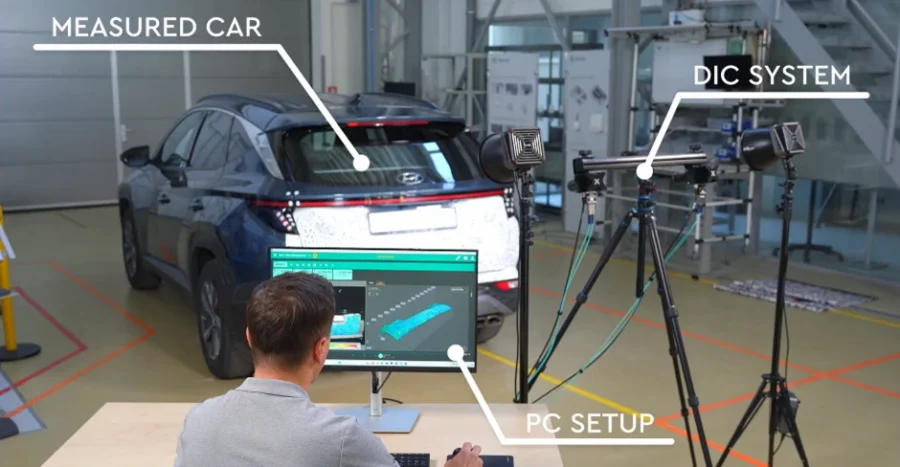
To evaluate the kinematic behaviour, oscillations and deformation of the car boot mechanism during the closing sequence, a dynamic measurement campaign was conducted using a 3D Digital Image Correlation (DIC) system.
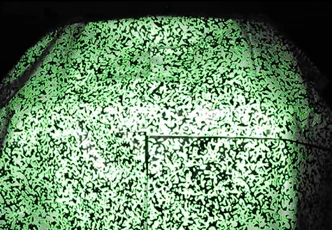
A large speckle-patterned calibration cloth was first employed to quickly establish an accurate stereo-camera calibration across the required measurement volume in Alpha DIC software.
Afterwards, a speckle pattern was applied to the front and side surfaces of the boot, which serves as a stable reference area for robust definition of DIC Areas as well as placement of virtual Point and Line Probes.
This way, displacement, deformation and hinge kinematics can be precisely recorded.
High framerate acquisition ensured reliable capture of structural responses.
KEYWORDS
- Dynamic testing
- Boot door motion
- High-speed measurement
- 3D deformation analysis
- Oscillation inspection
TEST SET-UP
- X-Sight 3D DIC Dynamic System X2300
- Hyundai Tucson (measured car)
- Speckle-patterned calibration cloth
- Alpha DIC® modules: AX3D, DIC, PP
- Alpha DIC software tools:
◦ Point Probe
◦ Line Probe
◦ DIC Area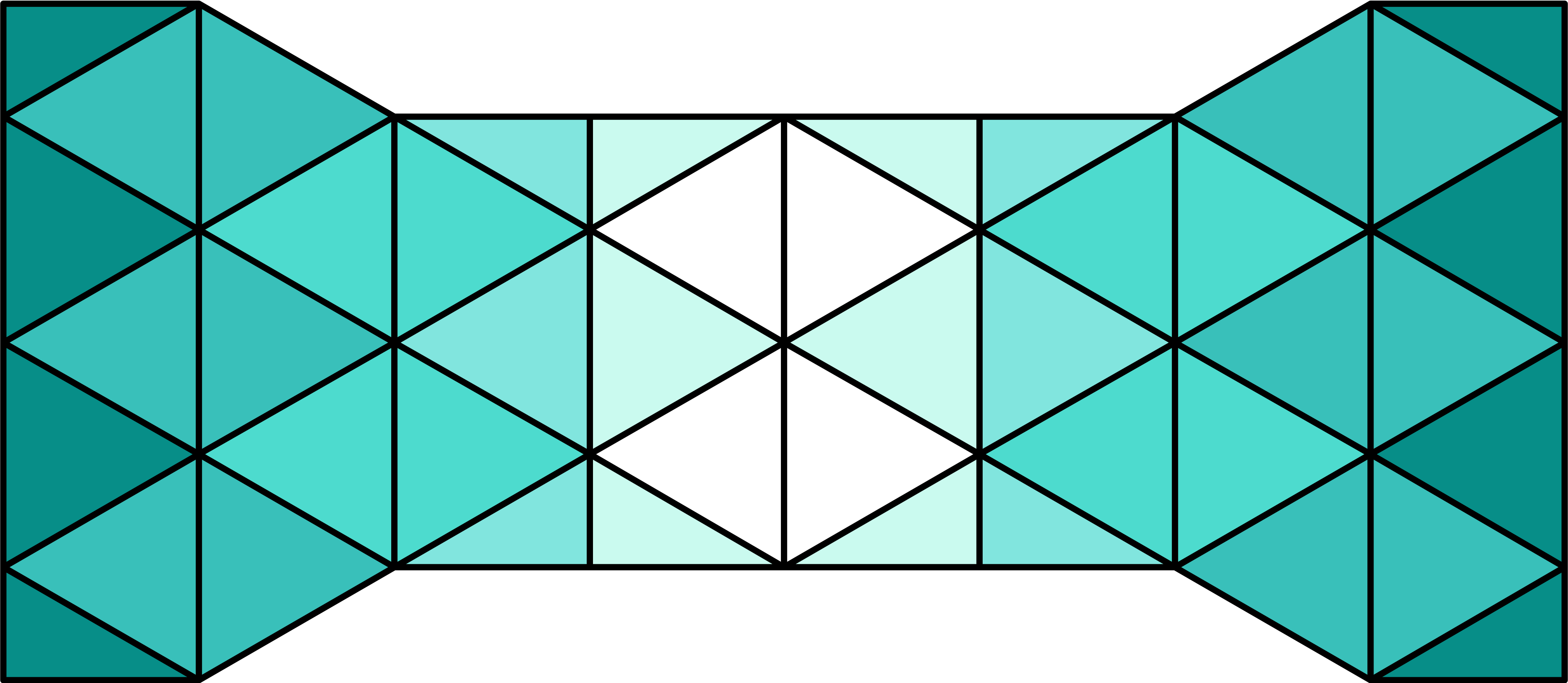
OUTPUT
- Side rim dampened oscillation
- Full-field resolution XYZdisplacement map
- Strain prediction and critical-point verification (model analysis)
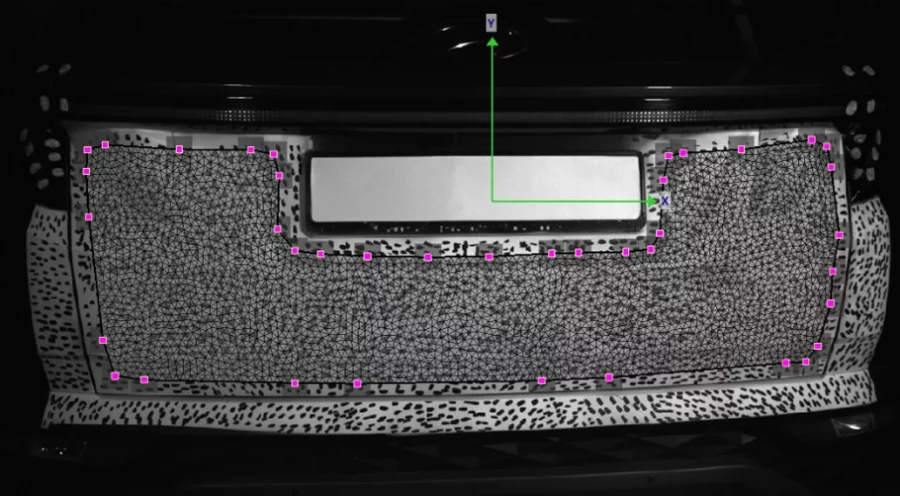
Wireframe Mesh (3000 points)
Measurement Process and Tools
The car boot closing motion was captured by two 2 MPx high-performance XIMEA cameras reaching up to 4100 Hz at VGA resolution (corresponding to 640×480 pixels) with real time speed sensing capabilities (at 0.5 MPx, they can even go up to 10 kHz as the maximum achievable framerate). Interface used here is the PCIe Gen3 bus (64 Gbit/s). The Point and Line Probes were used to measure displacement and length change in the specified direction, respectively. In this case, both probe configurations could be implemented for the side rim dampened analysis.
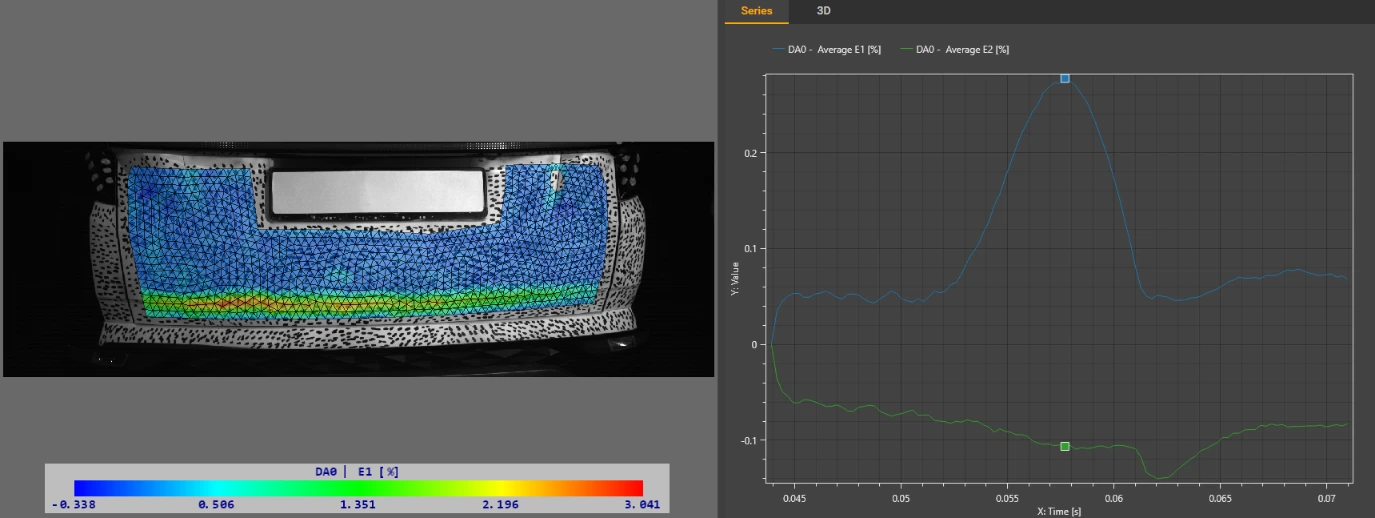
Full-field analysis is possible thanks to the DIC Area tool to obtain a strain distribution map over the full visible section of the measured area with a speckle pattern. When working with costumer goods and commercial products, particularly in automotive industry, strain prediction and critical-point verification is crucial for model design and its functionality.
Measurement Evaluation
The dynamic response of the car boot relative to the vehicle body was recorded at a sampling frequency of 4750 Hz, enabling accurate capture of the transient side rim dampened oscillation immediately after closure. The 3D Dynamic DIC system resolves the damped oscillations of the car boot in all three spatial directions (or together as XYZ), allowing the decay of amplitude and the rate of stabilization to be quantified with high precision. This evaluation provides a reliable verification of the car boot settling behaviour, supporting the assessment of hinge dynamics, damping performance, and the overall stability of the closing mechanism.
There are multiple ways how to approach the measurement:
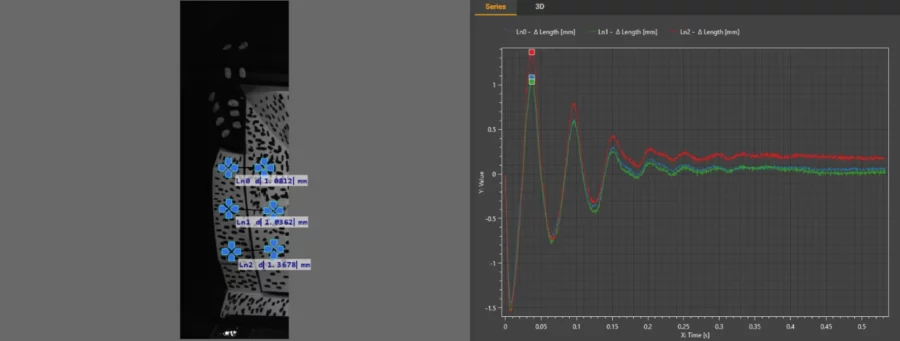
- Line Probe (quantity: ΔLength [mm])
Damping ratio computation:
The damping ratio ζ is a dimensionless measure of how much oscillations decay in a vibrating system. Its value can be gained from the amplitudes and time stamps in 2D graph via this equation:

where δ is logarithmic decrement of the peaks of decaying vibration.
For values 0 < ζ < 1, the system is underdamped (with oscillatory decay). The measured damping ratio is approximately 0,12, which is below the commonly referenced threshold of 0,20.
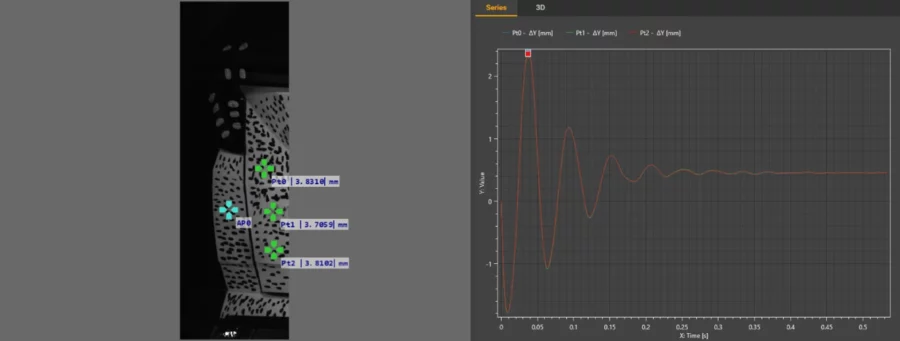
- Points Probes and Anchor Point (quantity: ΔY [mm])
An anchor point is a fixed reference point used to stabilize the coordinate system and ensure that all measured displacements and deformations are evaluated relative to a stationary location.
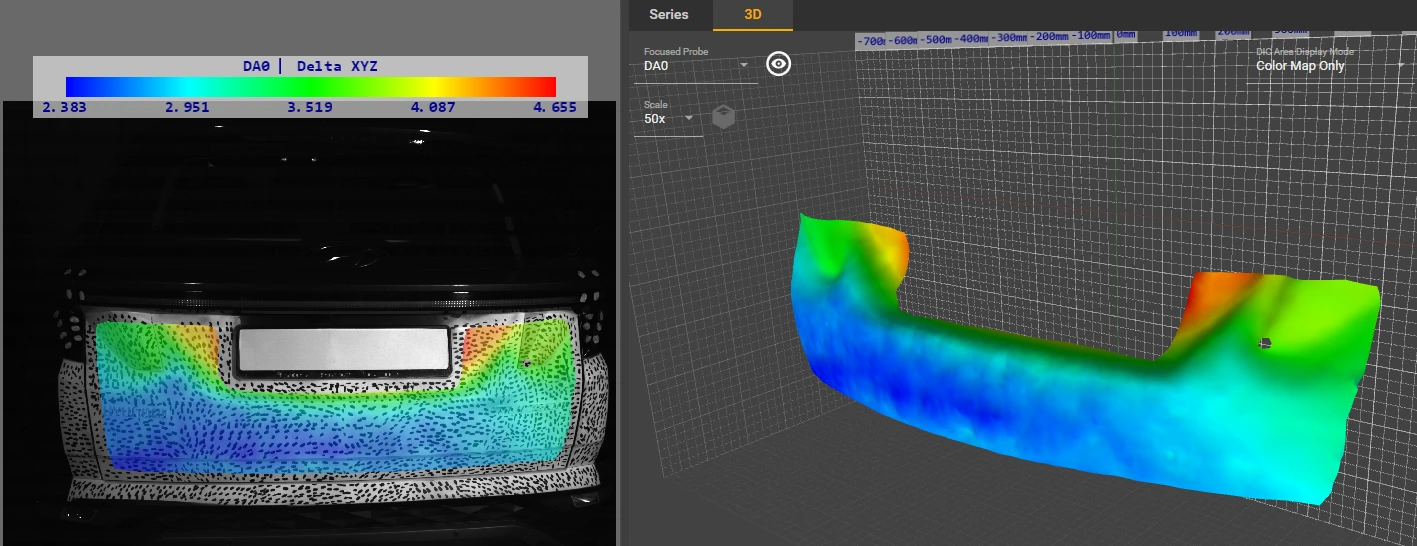
A full-field measurement of the entire car boot structure is performed at a frequency of 2375 Hz. The resulting data is visualized on a 3D ΔXYZ-displacement map and a 3D graph (see Figure 6).
This analysis enables the prediction of stress distribution and identification of potential material failure. Such insights are critical for detecting structural weak spots and validating design integrity. Additionally, this method can be applied for model evaluation and comprehensive structural analysis of the car boot, supporting optimization of both geometry and material performance.
In Figure 7, the highest concentration of strain was measured in general region where two sheet metal parts are connected (shape joint), which considerably shows the probable place, where the stress accumulates, and material may later fail due to fatigue.
 Download PDF version of this report here